Early-onset type 1 diabetes and the young adult brain
At a mean age of 19, 31 young adults with early-onset type 1 diabetes did not differ from sibling controls in grey matter on a corrected test. Uncorrected maps suggested subtle left-hemisphere differences.
The idea
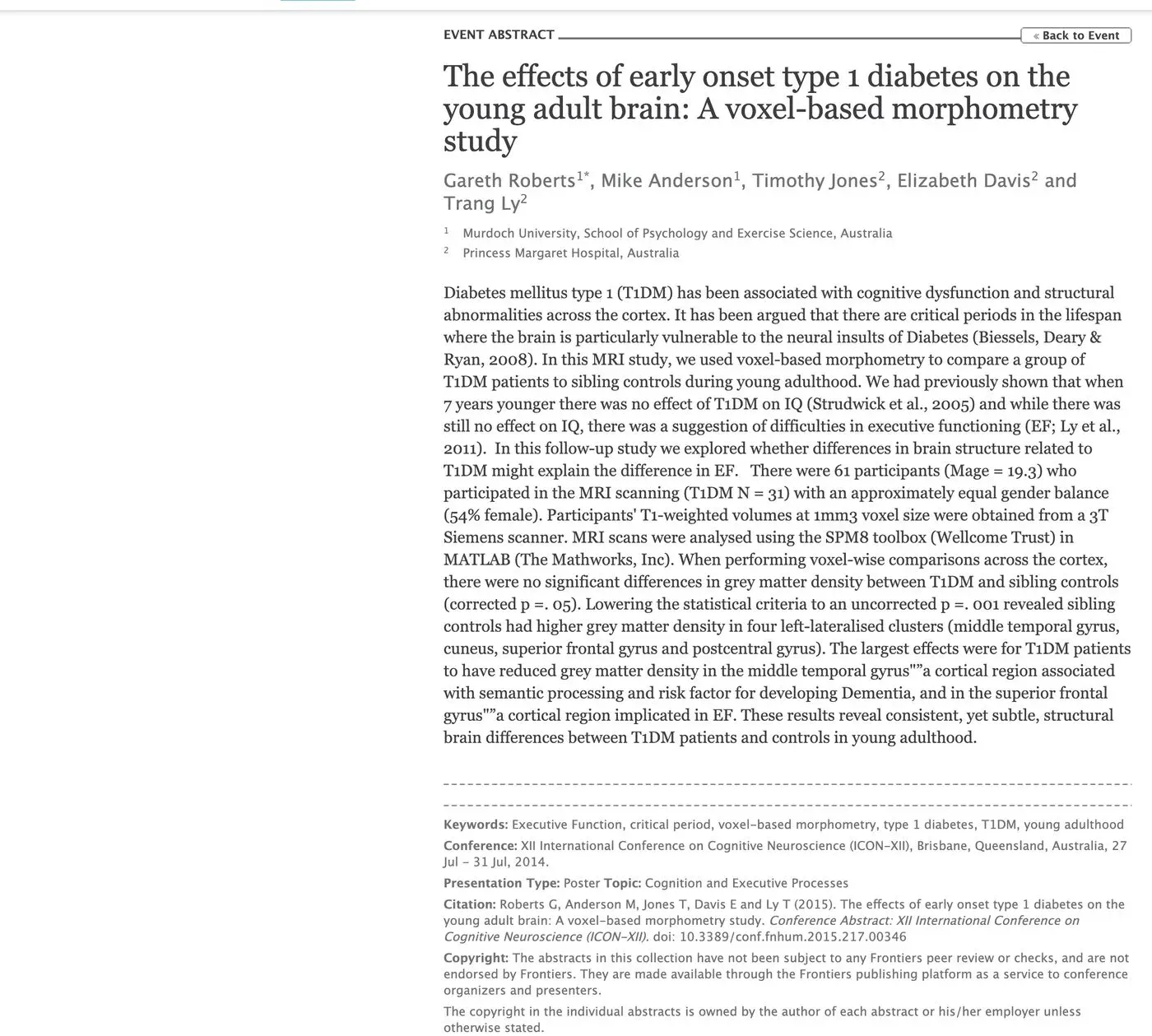
Early-onset type 1 diabetes has been tied to cognitive difficulties and to structural change in the cortex, on the argument that some ages are more vulnerable than others. This MRI study followed a cohort that, seven years earlier, had shown no IQ effect of diabetes and only a suggestion of executive-function difficulty. The question was whether brain structure in young adulthood would account for that gap.
The approach
Sixty-one participants, mean age 19.3, were scanned, 31 of them with type 1 diabetes, and about half were women. T1-weighted volumes at 1 mm cubed from a 3T Siemens scanner were compared with voxel-based morphometry in SPM8. Corrected voxel-wise tests found no grey-matter difference between the patients and sibling controls. At an uncorrected threshold, sibling controls had higher grey-matter density in four left-hemisphere clusters: middle temporal gyrus, cuneus, superior frontal gyrus, and postcentral gyrus. The largest of those hints were in middle temporal cortex and superior frontal cortex. The abstract's own summary is consistent but subtle structural differences.
- 61 participants, mean age 19.3; 31 with type 1 diabetes
- Sibling controls, 3T structural MRI, SPM8 voxel-based morphometry
- No grey-matter difference at a corrected threshold
- Uncorrected maps: four left-hemisphere clusters
- Roberts, Anderson, Jones, Davis, and Ly. Frontiers in Human Neuroscience conference abstract, ICON-XII
The paper: www.frontiersin.org .