EEG coherence and response conflict in 7- and 9-year-olds
In 45 children recorded at seven and again at nine, flanker conflict raised theta coherence from left prefrontal to parieto-occipital cortex only at the younger age.
The idea
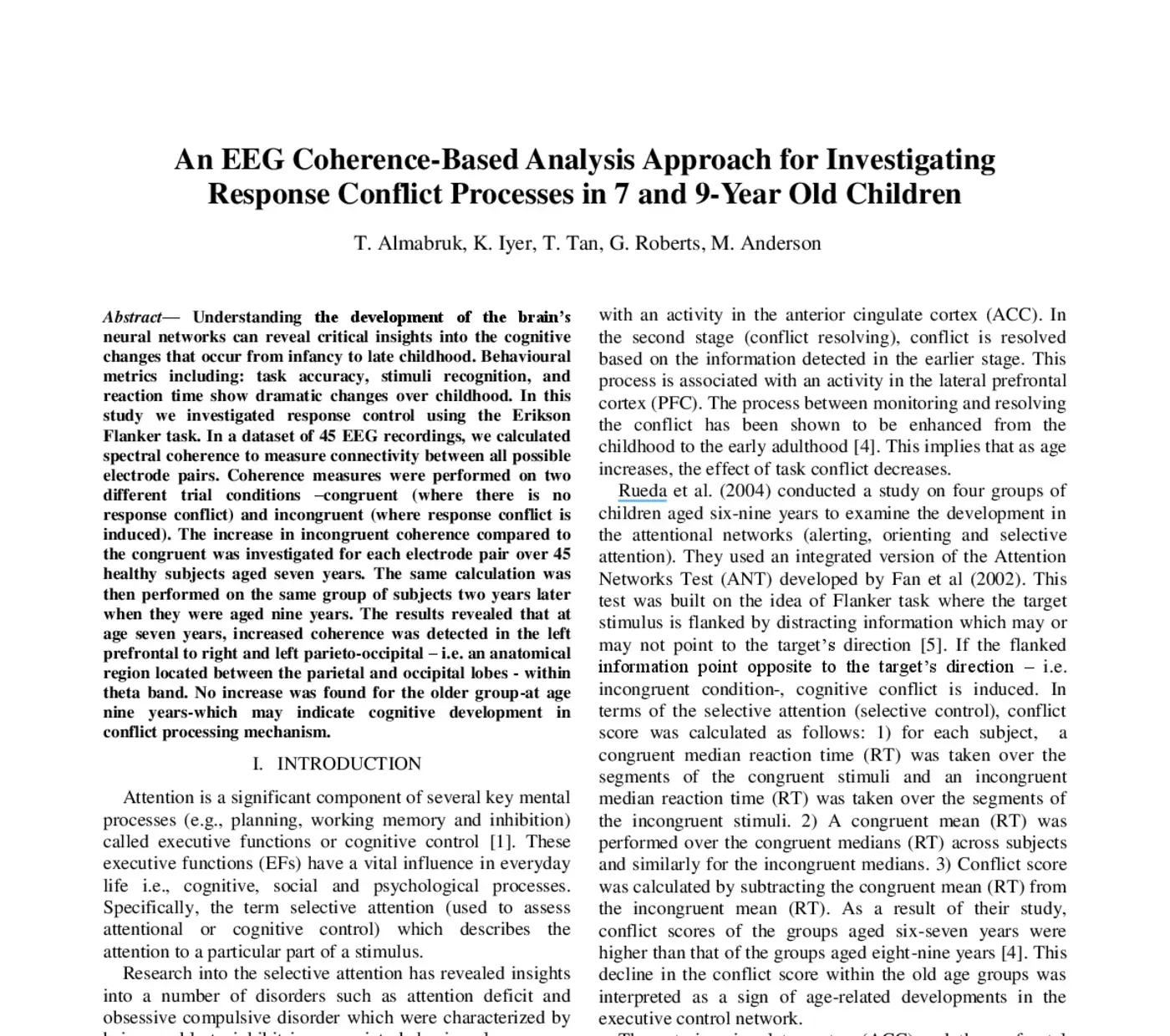
Response control is still changing across middle childhood. This conference paper measures it with spectral coherence on the Eriksen flanker task, so the result is coupling between sites rather than power at one electrode. Forty-five children were recorded at seven, and the same children again at nine.
The approach
Coherence on incongruent trials was compared with coherence on congruent trials, for every electrode pair. At seven, incongruent trials increased theta-band coherence from left prefrontal sites to right and left parieto-occipital sites. At nine, that increase was gone. The paper treats the change as development of the mechanism that handles response conflict.
- 45 children at seven, and the same children at nine
- Eriksen flanker task, congruent versus incongruent
- Spectral coherence across electrode pairs
- Theta coherence rises with conflict at seven, not at nine
- Almabruk, Iyer, Tan, Roberts, and Anderson. IEEE EMBC 2015
The paper: researchportal.murdoch.edu.au .